



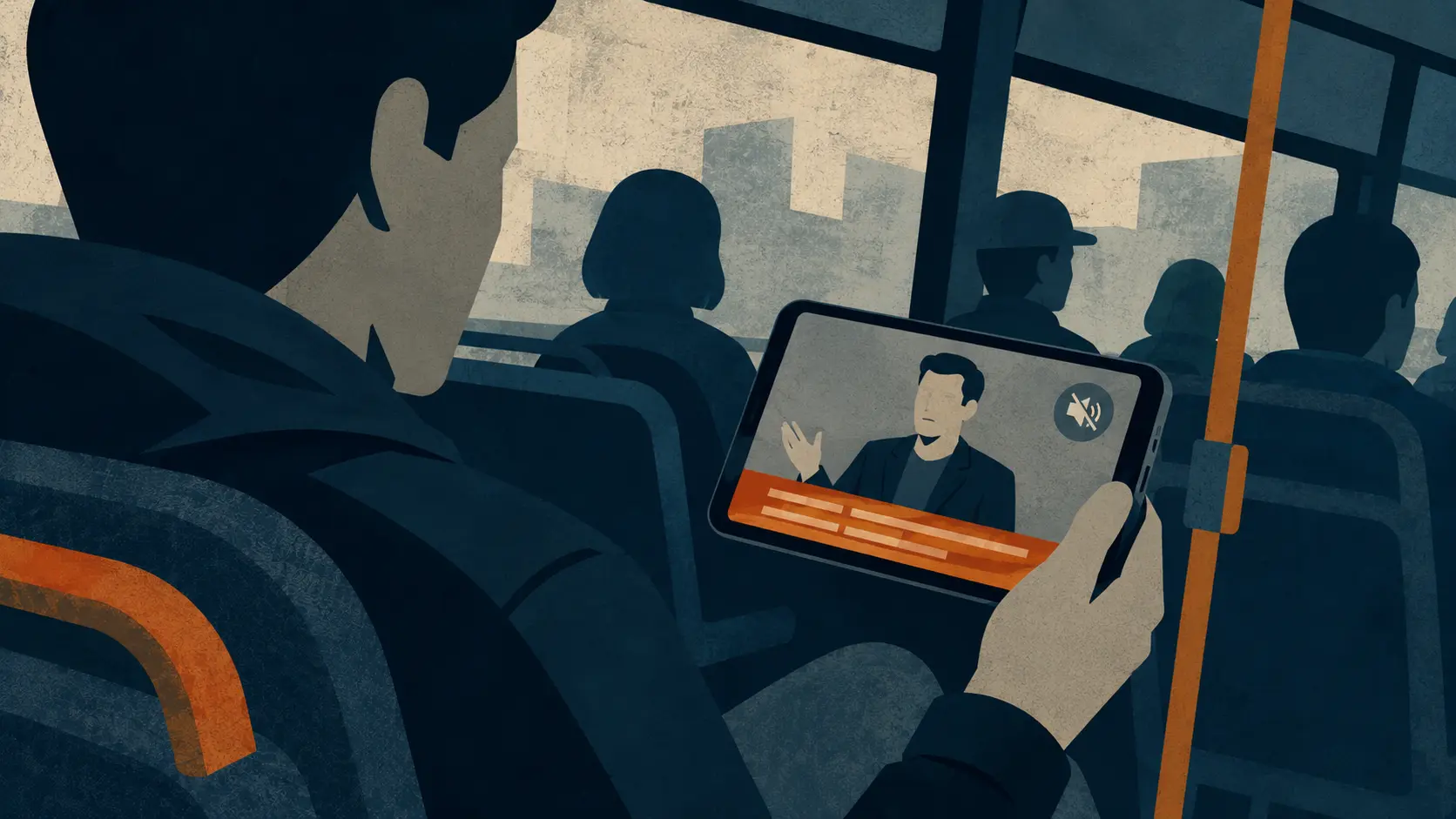
Most articles on this topic list the same three reasons: people are in public, phones autoplay muted, headphones aren't always handy. All true, and all missing the more interesting part. Researchers have actually studied what happens inside a viewer's head when they watch video without sound, and it's not a neutral experience. It comes with a measurable cost.
Sound-off viewing is the practice of watching video content with the audio muted, either by choice or by a platform's default autoplay setting. It happens because of environment, habit, and platform design working together. Most commonly observed on mobile social feeds, where the majority of video is played without the viewer ever tapping to unmute.
The Real Reasons People Mute Videos
A survey of 5,616 US consumers, conducted by Verizon Media and ad buyer Publicis Media, found the most common reasons people gave for watching without sound: they were in a quiet space, they didn't have headphones on hand, they were waiting in line, or they were multitasking. None of these are really about the content, they're about the situation the viewer is in when they open the app.
Platform design reinforces the habit further. Facebook, Instagram, and LinkedIn all autoplay video muted by default, and unmuting requires a deliberate tap most people simply don't make. Over time, this turns sound-off into the default state of mind before a video even starts playing, not a conscious choice made video by video.
There's also a control factor. Watching muted lets a viewer preview content and decide if it's worth their attention before committing to sound, especially useful for fast scrolling through a feed. If something visually catches their eye, they might unmute. Most of the time, they don't need to.
What Actually Happens When You Watch Without Sound
This is the part most articles skip. A mixed-methods eye-tracking study found that watching video without sound measurably increases cognitive load and reduces comprehension, immersion, and enjoyment, compared to watching with sound. Researchers tracked participants' gaze patterns and found that without audio, viewers had to process visual information and any available text more intensively just to follow what was happening. The absence of sound wasn't neutral, it was an added mental tax on every viewer choosing, or defaulting, to watch muted.
That's a different claim than "some people can't hear the audio." It's that watching without sound is inherently more cognitively demanding, for everyone, regardless of hearing ability. A viewer scrolling muted isn't getting a slightly reduced version of your video, they're working harder to follow a version of it that's missing a channel of information entirely.
How Widespread Is This, Really
Research reported by Digiday found that 75 percent of people say they often keep their phone on mute even while watching a video, with the habit varying by generation, 85 percent among Millennials versus 64 percent among Gen X. Verizon and Publicis Media's research separately found 92 percent of mobile users and 83 percent of desktop users report watching video with the sound off. Different methodologies, similar conclusion: sound-off is not a minority habit anywhere in the funnel.
When people are more likely to unmute
- Content that's visually intriguing enough to make them curious about the audio
- Private settings like at home, alone, with headphones already in
- Longer-form content they've already decided to commit to watching
When sound-off is essentially guaranteed
- Scrolling in public: commuting, waiting rooms, offices, shared spaces
- The first few seconds of any video in a feed, before a viewer decides it's worth their attention
- Any platform where autoplay defaults to muted, which covers most major social apps
Frequently Asked Questions
Why do people watch Reels without sound?
Mostly environment and habit. Research from Verizon and Publicis Media found the top reasons are being in a quiet space, not having headphones, waiting in line, or multitasking, reinforced by platforms that autoplay video muted by default.
What percentage of people watch video without sound?
Estimates vary by study and platform, generally in the 75 to 92 percent range for mobile viewing specifically. The exact number moves depending on methodology, but every major study agrees sound-off is the majority behavior, not the exception.
Does watching without sound actually affect comprehension?
Yes. An eye-tracking study found that watching video without sound measurably increases cognitive load and reduces comprehension and enjoyment compared to watching with sound, regardless of the viewer's hearing ability.
Is sound-off viewing more common on certain platforms?
It's widespread across Facebook, Instagram, LinkedIn, and similar feeds that autoplay muted by default. Platforms without autoplay-muted defaults tend to see somewhat higher sound-on viewing.
Does this habit vary by age group?
Some research suggests it does, one study found 85 percent of Millennials keep their phone on mute while watching video compared to 64 percent of Gen X, though sound-off remains common across all groups measured.
Watching video without sound isn't a fringe habit, research puts it anywhere from 75 to 92 percent of mobile viewers depending on the study, driven by environment, habit, and platforms that autoplay muted by default. It's also not a neutral experience: eye-tracking research found that watching without sound measurably increases cognitive load and reduces comprehension, for every viewer, not just those who can't hear. A video without a way to follow along visually is working against the way most people actually watch it.
Since sound-off is the default rather than the exception, the video itself needs to carry the message without audio, and that only works if the on-screen text is accurate. Here's a complete breakdown of every method for getting that right, including where automatic accuracy tends to fall short.