



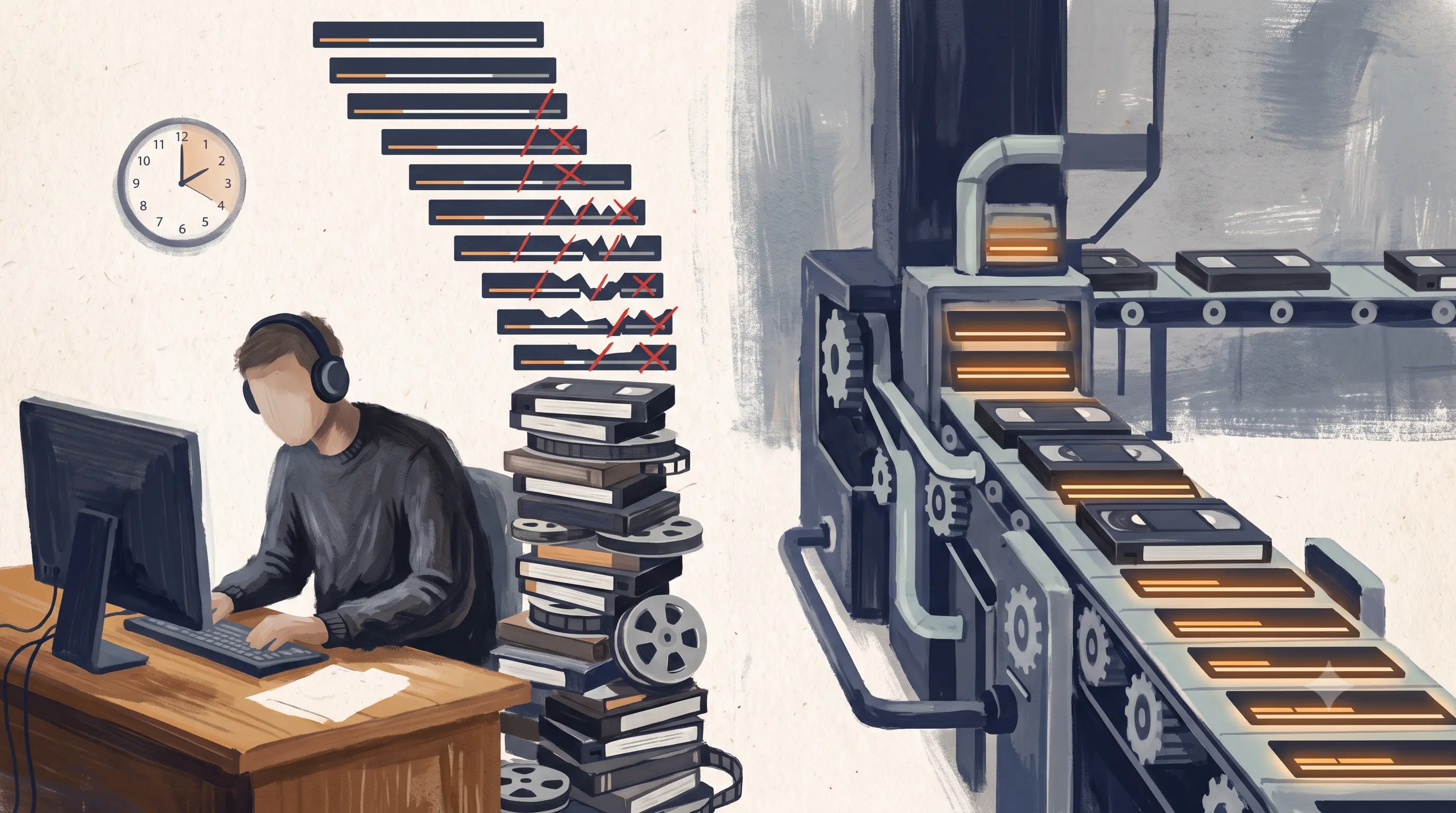
Most "manual vs AI captions" articles frame this as a speed argument: AI is faster, manual is more careful, pick your trade-off. That framing skips the more useful question. Manual transcription accuracy isn't a fixed number, and neither is AI's. Both degrade in specific, documented ways, and for Indian accents and Hindi-English code-switching specifically, they degrade differently. That's the comparison actually worth making.
Manual subtitle transcription is the process of a person listening to a video's audio and typing out the spoken content by hand, timed to match the speech. It works by relying entirely on the transcriber's listening comprehension, familiarity with the language or accent, and sustained attention. Most commonly used when precision matters more than speed, or when automated tools don't handle the specific speech pattern well.
What Manual Transcription Actually Gets Right
Under good conditions, a careful human transcriber is genuinely accurate. Academic research on professional transcription found error rates of 4.1 to 4.5 percent for careful, unhurried work, close to the ceiling of what manual transcription can achieve. That's not a strawman to knock down, it's real, and it's why manual transcription remains the standard in legal and medical contexts where every word matters.
The catch is in the qualifier: "careful, unhurried work." Manual accuracy isn't a property of the method itself, it's a property of the conditions under which it happens.
The Two Things That Erode Manual Accuracy
Fatigue is measurable and fast. Research on transcription work found accuracy drops from 98 percent in the first hour to 94 to 95 percent after four to five hours of continuous work. The same study that found 4.1 to 4.5 percent error rates for careful transcription also found "quick," rushed transcription runs closer to 9.6 percent, roughly double. A person transcribing their first video of the day and their fifteenth video of the day are not producing the same quality of work, even if they're equally skilled.
Familiarity with the specific speech pattern matters more than general skill. A transcriber who's excellent at clear English can still make real, systematic errors transcribing Hindi-English code-switching if they're not fluent in how that mixing actually works, when a word shifts language mid-sentence, how mixed vocabulary gets conventionally spelled, which slang carries meaning a literal transcription would miss. General transcription skill and code-switching fluency are different competencies, and daily-volume content in Hindi, Hinglish, or a regional language needs both.
For a creator or small team producing subtitles by hand every day, both of these problems compound. You're not choosing "manual accuracy" as a fixed quantity, you're choosing whoever's doing the transcribing on a given day, at whatever hour, for however many videos are left in the queue.
Where Generic AI Falls Short in a Different Way
Generic AI transcription tools don't get tired, but they have their own accuracy problem, and for Indian accents and code-switching, it's a significant one. Research on code-switched speech corpora found that automatic speech recognition models see a 30 to 50 percent increase in Word Error Rate when transcribing code-switched audio like Hinglish, compared to single-language input. That gap exists because most mainstream models are trained and benchmarked primarily on clear, single-language English audio, the speech pattern most Indian daily content simply doesn't match.
This means the honest comparison isn't "manual is accurate, AI is fast." It's that manual transcription has a volume-and-familiarity problem, and generic AI has a training-data problem, and for Hindi-English code-switched content specifically, both problems land on the same speech pattern from different directions.
What Accent-Specific AI Actually Changes
ButterCut's transcription is trained specifically on Indian accents and Hindi-English code-switching, which addresses the generic-AI gap directly, it's not guessing at a speech pattern it wasn't built for. It also doesn't fatigue at volume the way manual transcription does, the hundredth video gets the same underlying model as the first.
The honest limit: no automated system claims to match a slow, careful, native-fluent human transcriber working on a single, high-stakes video with unlimited time. For daily-volume content, where the realistic manual alternative is a rushed transcription late in a long shift, not a leisurely, careful one, that comparison changes. See how it performs on one of your own Hindi or Hinglish clips against your actual daily conditions, not a best-case manual benchmark.
Frequently Asked Questions
Is manual subtitle transcription more accurate than AI?
Under ideal conditions, careful manual transcription can be very accurate, research shows error rates around 4 to 5 percent for unhurried work. That accuracy depends heavily on the transcriber's familiarity with the specific accent or language mix and how much time they have, neither of which holds steady at daily posting volume.
Does manual transcription accuracy stay consistent throughout the day?
No. Research found transcription accuracy drops from about 98 percent in the first hour to 94 to 95 percent after four to five hours of continuous work, a documented fatigue effect that applies regardless of skill level.
Why does AI struggle more with Hindi-English code-switching?
Most mainstream transcription models are trained primarily on clear, single-language English audio. Research on code-switched speech found error rates increase 30 to 50 percent on mixed-language audio compared to single-language input, a direct result of that training gap.
Is AI transcription good enough for daily-volume Indian content?
It depends on whether the model was built for that specific speech pattern. Generic AI shows real accuracy gaps on Hindi-English code-switching. Accent-specific AI is built to close that gap, and doesn't degrade with volume the way manual transcription does.
Manual transcription accuracy isn't fixed, it depends on the transcriber's familiarity with the specific accent or language mix and holds up worse than expected past a few hours of continuous work. Generic AI has a separate, well-documented accuracy gap on Hindi-English code-switching, since most models are trained on clear single-language English. The realistic daily-volume comparison isn't careful manual work against generic AI, it's rushed manual work against a model actually built for the speech pattern in question.
If your subtitle workflow depends on whoever's available and however tired they are by the fifteenth video, that's a fatigue problem, not an accuracy strategy. Start a free ButterCut trial and compare it against your actual daily conditions.
Sources
- BrassTranscripts, on cognitive load and fatigue in transcription accuracy
- Disfluencies and Human Speech Transcription Errors, on professional transcriber error rates
- NCBI/PMC: HiACC Hinglish code-switched speech corpus study
- NCBI/PMC, analysis of speech recognition and transcriptionist review error rates