



The usual advice for a boring talking-head video is performance coaching: be more animated, smile more, work on your energy. Some of that helps. None of it is what eye-tracking researchers actually found when they studied what happens inside a viewer's attention while watching one. The real finding is more specific, and more useful, than "be more engaging."
A talking-head video is a video format where a single person speaks directly to camera for most or all of the runtime, common in interviews, explainers, testimonials, and educational content. It works by relying on the speaker's face and voice to carry the entire message, with minimal visual variation elsewhere in frame. Most commonly used because it's the cheapest, fastest format to produce, one person, one camera, no additional production required.
What Eye-Tracking Research Actually Shows
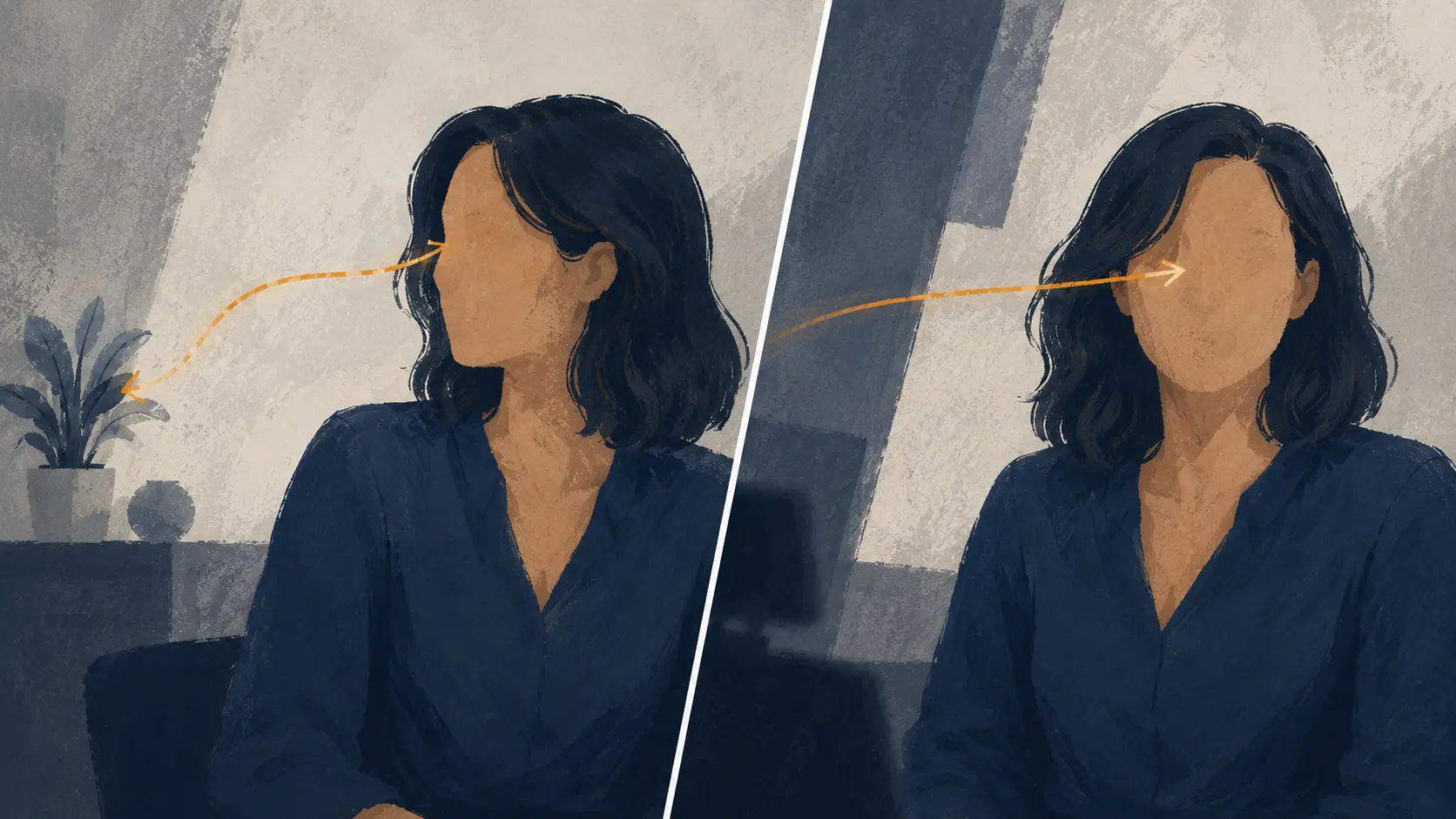
Nielsen Norman Group's eye-tracking research on talking-head video found something specific: when the visual stays the same for too long, viewers don't necessarily look away from the video entirely. Their eyes start scanning other elements within the frame, a plant in the background, an object on a shelf, anything else in the shot, while they keep listening to the audio. In one tracked segment, a viewer's fixations drifted away from a static speaker's face toward a plant behind him, not because the audio stopped being interesting, but because the visual sameness of an unchanging face had nothing left to hold his gaze.
That's a more precise diagnosis than "boring." The viewer hadn't disengaged from the content. Their visual attention had simply run out of anything new to look at, and it went looking elsewhere in the frame instead. The same research found that split-screen or multi-angle segments produced measurably different attention patterns than static single-angle footage, viewers' fixations moved between the added visual elements rather than drifting off to the background.
The Real Fix Isn't Performance Coaching
The researchers were direct about the actual fix: the single most important technique for keeping visual interest is to frequently change the visual, not the speaker's energy level, the visual itself. A change in facial expression helps a little. A genuine change in camera angle, framing, or subject position does more, because it gives the viewer's eyes something legitimately new to track rather than asking them to keep finding interest in a face that hasn't moved.
This reframes what "engaging" actually means for this format. It's not primarily about how animated the speaker is. It's about whether the visual field itself is giving a viewer's attention somewhere to go, on a timescale before it starts wandering to the background on its own.
The Honest Trade-off Talking Heads Actually Have
It's worth being straight about a genuine complication here, not every study on talking heads points the same direction. Academic research on talking heads in educational video found a real trade-off: the presence of a visible speaker measurably hurt viewers' recall of factual information, likely from the added cognitive load of processing a face alongside the content, while at the same time increasing viewers' satisfaction and their sense of having learned something.
In other words, a talking head can make content feel more trustworthy and personal even while making the specific facts harder to retain. That's not an argument against the format, most Reels and Shorts aren't trying to transmit dense factual information anyway, but it's a reason to be honest that "add a face" isn't automatically the engagement upgrade it's often assumed to be. The visual variety fix matters more for formats that are already committed to a talking head and need to solve for its specific weaknesses.
Where a static talking-head shot holds up fine
- Short clips well under the point where visual sameness has time to register
- Content where the speaker's authenticity or direct connection is the actual point
- Reaction or commentary formats where a static, close framing is part of the genre's expectation
Where it needs visual variety to hold attention
- Any talking-head segment running long enough for a viewer's gaze to start drifting to the background
- Explainer or educational content where factual retention matters, not just watch-through
- Content competing in a fast-scroll feed where a static shot has to earn continued attention against everything else in the feed
Frequently Asked Questions
Why do talking-head videos get boring?
Eye-tracking research found that when the visual stays static too long, viewers' eyes drift to other elements in the frame, background objects, anything else visible, even while they keep listening. It's a sign of visual, not necessarily content, fatigue.
Does being more animated on camera fix a boring talking-head video?
It helps somewhat, but the research points to changing the visual itself, camera angle, framing, subject position, as the more effective fix than performance energy alone.
Do talking heads actually help viewers learn or retain information?
Research on educational video found a real trade-off: talking heads increased perceived satisfaction and sense of learning while measurably hurting factual recall, likely due to added cognitive load.
How often should the visual change in a talking-head video?
The research doesn't specify an exact interval, but the core finding is that visual sameness itself causes attention drift, so a video benefits from a genuine visual change well before a viewer's gaze has time to wander.
Is a talking-head format a bad choice for Reels?
Not inherently, it's the most accessible format to produce and connects well with viewers. The research suggests the fix isn't avoiding the format, it's breaking up visual sameness within it.
Talking-head video gets boring for a specific, measurable reason: eye-tracking research shows viewers' gaze drifts to background elements when the visual stays static too long, even while they keep listening. The documented fix is changing what's visually on screen, not coaching the speaker to be more animated. There's also an honest trade-off worth knowing, talking heads can increase viewer satisfaction while measurably hurting factual recall, so visual variety matters more for content that needs both attention and retention.
Breaking up a static shot by hand means finding and placing a new cutaway before a viewer's attention has time to wander, for every video. This guide covers the full toolkit for polishing talking-head content, without redoing that work manually each time.