



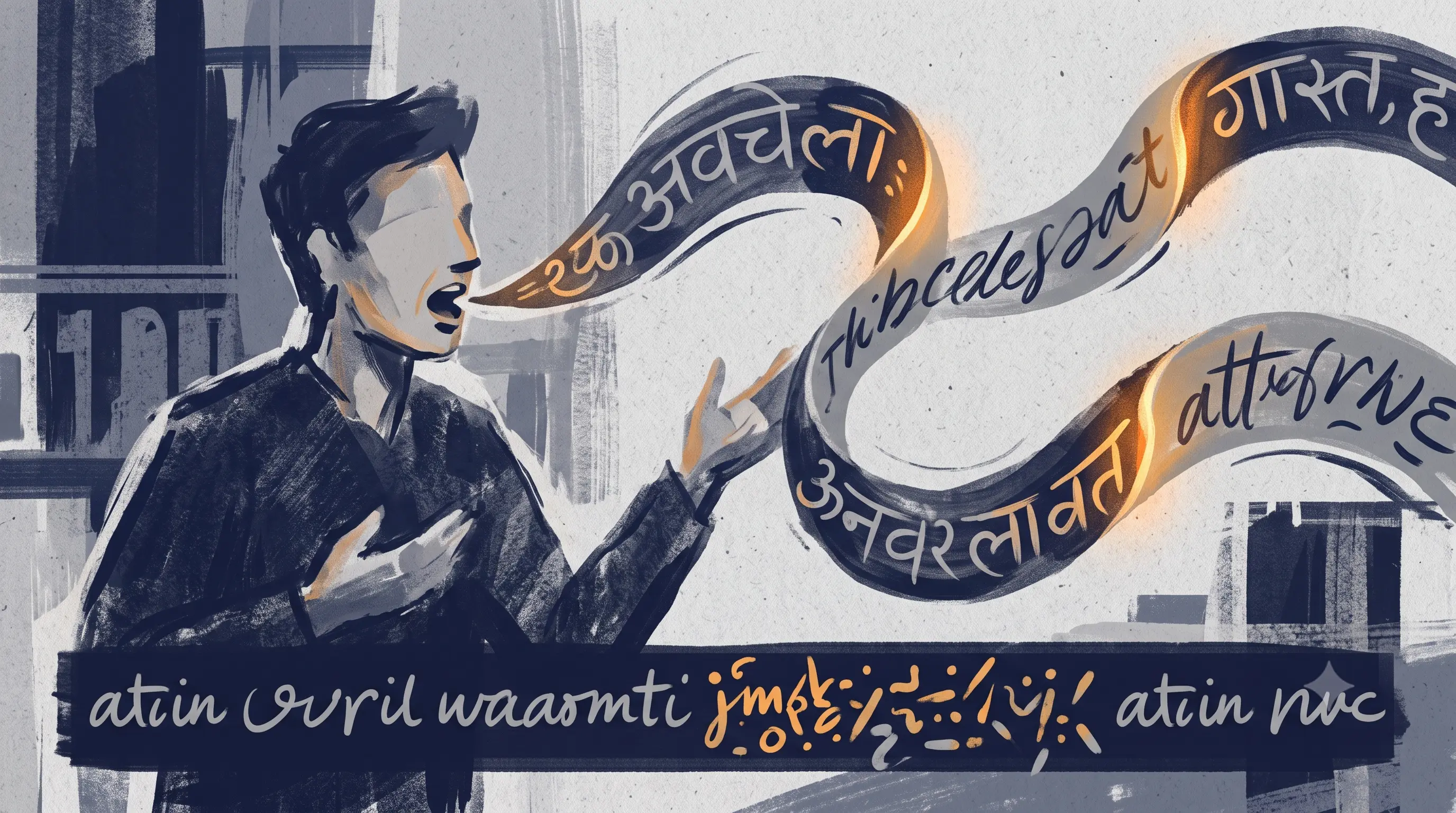
You're not speaking broken English or incorrect Hindi. You're speaking Hinglish, the way most Indian creators actually talk on camera, moving between languages mid-sentence without thinking about it. Most captioning tools weren't built for that. They were built for one language at a time, and code-switching breaks their core assumption.
Code-switching is the practice of moving between two or more languages within the same conversation or even the same sentence, common in Hindi-English speech across India. It works as a natural part of bilingual speech, not an error or inconsistency, speakers switch based on which word or phrase fits the thought best. Most commonly a transcription challenge for tools built around single-language speech recognition.
Why Generic Captioning Tools Struggle With This Specifically
Research on code-switched speech corpora found that automatic speech recognition models see a 30 to 50 percent increase in Word Error Rate when transcribing code-switched audio, compared to single-language input. That's not a small accuracy dip, it's a substantial jump in the number of words a tool gets wrong, concentrated exactly on the sentences where language shifts mid-thought.
The mechanism is straightforward. Most mainstream transcription models are trained primarily on clear, single-language audio, overwhelmingly English. When a model built that way encounters a sentence that starts in Hindi and finishes in English, or vice versa, it's working outside the pattern it was optimized for. It might transcribe the Hindi portion in English phonetics, miss the language switch entirely, or produce a caption that's technically words but doesn't read the way the sentence was actually spoken.
What This Looks Like in Practice
A creator says something like "yeh product bahut hi amazing hai, seriously try karo," a completely normal Hinglish sentence. A tool tuned only for English might render this as fragmented English words with the Hindi portions garbled or dropped. A tool tuned only for Hindi might struggle with the English words embedded mid-sentence, especially casual English that doesn't map cleanly to formal vocabulary. Neither failure mode is about the speaker doing anything wrong, it's about the tool's model not accounting for the switch itself.
This is different from simply supporting "Hindi" as a language option. A tool can list Hindi in its language menu and still handle code-switching poorly, because transcribing clean, monolingual Hindi and transcribing Hindi-English code-switching are genuinely different tasks for a speech recognition model, even if they sound similar to a person setting up the tool.
Why This Matters Beyond Accuracy
Garbled captions on code-switched speech don't just look sloppy, they undercut the exact viewers most likely to engage with the content. Research published by Meta found captions increase average view time by 12 percent, and most Reels get watched with the sound off. If the caption doesn't match what a Hinglish-speaking viewer is used to seeing, the visual text and the spoken audio stop reinforcing each other, and some of that engagement benefit disappears specifically for the audience the content was made for.
Our Pick: ButterCut, Built Around This Specific Pattern
ButterCut's transcription is trained on Hindi-English code-switching directly, not adapted from a monolingual model after the fact. It's built to recognize when a sentence shifts language mid-thought and transcribe both portions accurately, the way the sentence was actually spoken, not a fragmented approximation of it.
The honest scope: this is specifically about code-switched speech accuracy. If your content is entirely in clear English, or entirely in one Indian language without mixing, several general-purpose tools handle that well already. Test it against a genuinely Hinglish clip and see how it holds up against your actual speech pattern.
Where code-switching accuracy matters most
- Talking-head content where the creator naturally mixes Hindi and English throughout
- Product reviews, vlogs, and commentary where casual, code-switched speech is the norm
- Daily posting volume, where manually correcting garbled captions on every video isn't sustainable
Where it matters less
- Content scripted and delivered entirely in one language without mixing
- Formal or educational content where speech naturally stays in a single register
Frequently Asked Questions
What is Hinglish and why is it hard for AI to caption?
Hinglish is the natural mixing of Hindi and English within the same sentence or conversation. It's hard for AI because most transcription models are trained primarily on single-language audio, and code-switched speech falls outside that pattern, research shows a 30 to 50 percent increase in transcription errors on code-switched audio.
Does listing Hindi as a supported language mean a tool handles Hinglish well?
Not necessarily. Transcribing clean, monolingual Hindi and transcribing Hindi-English code-switching are different tasks for a speech recognition model. A tool can support Hindi generally while still struggling specifically with mixed-language sentences.
Why do captions matter more for Hinglish content specifically?
Most Reels are watched with sound off, and garbled captions on code-switched speech break the connection between what's shown and what's actually being said, undercutting the exact audience the content was made for.
What's the best captioning tool for Hinglish content?
Look for a tool built and trained specifically on code-switched speech, not just one that lists Hindi in a language menu. The distinction matters more for accuracy than the language list alone suggests.
Hinglish, the natural mixing of Hindi and English mid-sentence, is a specific transcription challenge most captioning tools weren't built to handle, since their models are trained primarily on single-language audio. Research shows a 30 to 50 percent increase in transcription errors on code-switched speech compared to single-language input. Listing Hindi as a supported language doesn't guarantee code-switching accuracy, those are different tasks for a speech model. ButterCut is built specifically around this pattern.
If your captions keep garbling the exact sentences where you naturally switch between Hindi and English, start a free ButterCut trial and see how it handles a genuinely Hinglish clip.