



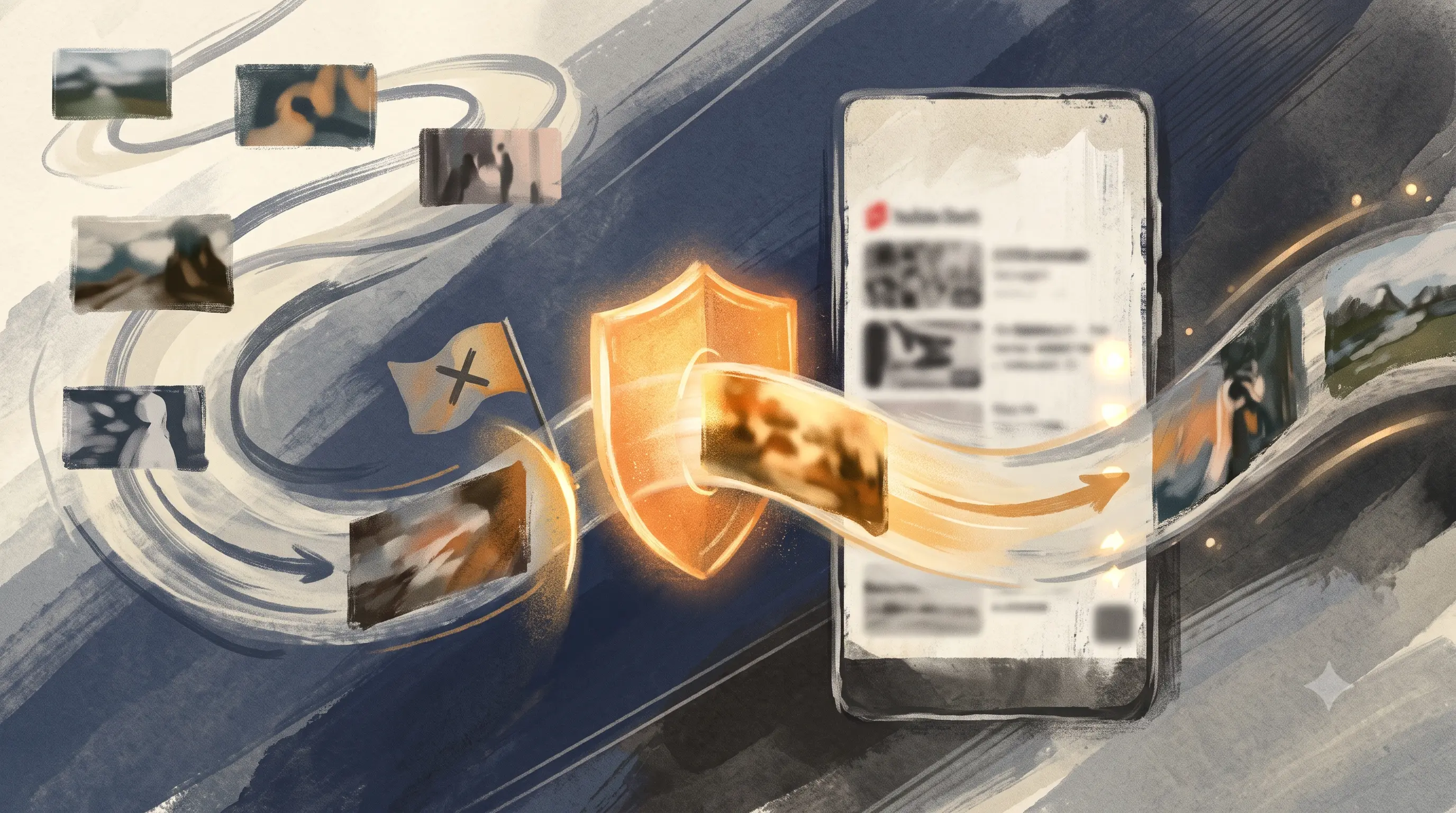
B-roll tools built for Reels don't automatically translate to Shorts, and it's not just about aspect ratio. YouTube runs Content ID, an automated copyright matching system that scans uploaded video against a database of claimed material. Stock or AI-generated b-roll sourced from a library with unclear licensing can trigger a claim on your Short, sometimes silently redirecting ad revenue to a rights holder, a risk Instagram's B-roll workflow doesn't carry in the same way.
A b-roll tool for YouTube Shorts is software that automatically inserts supplemental footage into short-form video published on YouTube, matched to the video's spoken content. It works the same way b-roll matching does anywhere, transcribe, extract keywords, match footage, but licensing and copyright provenance carry more weight here because of YouTube's automated Content ID scanning. Most commonly evaluated on footage licensing clarity as much as matching quality.
Why Content ID Changes the Calculus
YouTube's Content ID system automatically scans uploaded video against a database of copyrighted material submitted by rights holders. If b-roll footage in your Short matches something in that database, even a few seconds of stock footage improperly licensed for redistribution, your video can get a claim placed on it. Depending on the rights holder's settings, that can mean lost monetization on the video, not a takedown, but your ad revenue redirected elsewhere, or in stricter cases a strike against your channel.
This makes footage sourcing a bigger deal for Shorts specifically than it typically is for Reels, where this kind of automated claim system doesn't operate the same way. A b-roll tool's stock library licensing terms are worth checking directly, not assumed to be automatically safe because the clip appeared inside an editing tool.
The Options, What Matters for Shorts Specifically
1. Opus Clip: clip-detection strength, verify licensing on generated b-roll
Opus Clip's AI B-Roll on its Pro tier is a natural fit for creators repurposing long-form YouTube content into Shorts, since its clip-detection engine already works from full YouTube uploads. Confirm the licensing terms for AI-generated or stock b-roll specifically before assuming it's automatically clear for monetized Shorts.
2. Submagic: Storyblocks-sourced, licensed for this use case
Submagic's Magic B-Roll draws from Storyblocks, a licensed stock library, which reduces the Content ID risk compared to unclear-provenance sources. Starter runs $19/month, 15 videos, 2-minute cap, workable for Shorts under that length limit.
3. Generative tools (Runway, similar): originality reduces claim risk, verify output terms
AI-generated footage from a prompt is original by construction, which sidesteps Content ID matching against existing copyrighted material entirely. The trade-off is manual placement, generative tools don't automatically insert clips at the right timestamp, and cost scales with generation credits rather than a flat monthly fee.
Our Pick: ButterCut, for Indian-Language Shorts Specifically
ButterCut's transcription and b-roll matching are built around Indian accents and code-switched speech, relevant to Shorts the same way it is for Reels, since the same accuracy foundation drives both. If your Shorts run in Hindi, Hinglish, or a regional language, that's the specific gap worth checking against any tool's general claims.
The honest scope: confirm footage licensing terms directly for any tool before relying on it for monetized YouTube content, this matters more here than it does for Instagram-only workflows. Test it against one of your own Shorts.
Frequently Asked Questions
Can AI-generated b-roll get my YouTube Short claimed by Content ID?
It's possible if the footage source has unclear or improper licensing for redistribution. Content ID scans uploaded video against a database of claimed material, and stock or AI-sourced clips aren't automatically exempt.
Does Reels have the same copyright risk as YouTube Shorts?
Not through an equivalent automated system in the same way. YouTube's Content ID is specific to YouTube, which is why footage licensing carries more direct financial risk there than on Instagram.
What's the safest b-roll source for monetized YouTube Shorts?
Licensed stock libraries with clear redistribution terms, or genuinely original AI-generated footage, both reduce the chance of a Content ID match compared to unclear-provenance sources.
B-roll for YouTube Shorts carries a licensing consideration Reels doesn't face in the same way, Content ID can claim monetization on a Short if its footage matches copyrighted material in YouTube's database. Submagic's Storyblocks-sourced footage and genuinely original AI-generated clips both reduce that risk more than unclear-provenance sources. ButterCut's Indic-language accuracy applies the same way to Shorts as it does to Reels, worth checking against your specific language mix.
If your Shorts run in Hindi, Hinglish, or a regional language and the matching keeps missing, start a free ButterCut trial and test it directly.